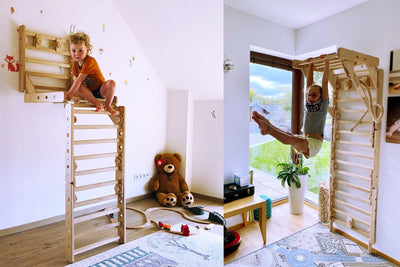
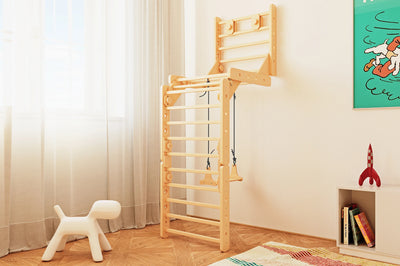

Create a Montessori playground and support children's natural movement
Share
Movement is part of healthy development for children – and it is fun. According to the World Health Organization (WHO), physical activity in children and adolescents promotes bone health, encourages healthy growth and development of muscle, and improves motor and cognitive development. Regular movement is also associated with better fitness and mental health.
Movement matters from the very beginning. The WHO recommends that even babies are physically active several times a day, particularly through interactive floor-based play. Children aged 1 to 4 should spend at least 180 minutes a day being physically active, spread throughout the day; for 3- to 4-year-olds, at least 60 minutes of that should be moderate- to vigorous-intensity. Babies do not need a climbing frame for this in their first year: according to the manufacturer, the smallest Loopo structures are suitable from 10 months. Children love to learn on the move – and a playful approach invites them to keep trying something new.
What does Montessori have to do with movement?
Montessori education places great emphasis on children being able to explore their surroundings independently. For a movement space, this means the child chooses whether to climb, balance or crawl, and sets their own pace. Open-ended elements that can be used in different ways leave room for creativity.
Maria Montessori wrote explicitly about movement, too. In “The Montessori Method” (1912) she describes how children of two and a half to three years moved themselves sideways along a low wire fence in the courtyard – and recommends such a little “fence” of parallel bars for playrooms: “I advise the manufacture of this little fence for use in children's playrooms.” A little spiral stairway with very low steps was also among her gymnastic apparatus.
By the way, the Pikler triangle does not come from Montessori: it is named after the paediatrician Emmi Pikler (1902–1984), whose approach centres on the child's independent motor development at their own pace. Both approaches share the idea that children should be free to move on their own initiative.
Loopo climbing frames: flexible elements for a movement space
For children who want more than passive entertainment, Loopo sets offer room for active play. The Pikler triangle in the Froggie set can be built in two versions (Small Pikler Triangle T1 and T2) and invites children to pull up, climb and balance – suitable from 10 months, according to the manufacturer. The Loopo Cliff offers seven structures with opportunities to climb, hang and swing. According to the product page it is designed for children aged 2 to 10, and according to the assembly instructions the wall-mounted Overhang and Wall Swing are for ages 3 and up. This creates many opportunities to practise coordination, balance and strength.
What movement can do for children
Active children train more than their muscles. The WHO associates regular physical activity in children and adolescents with better cognitive outcomes and better mental health. Toddlers in particular benefit from plenty of experience with climbing and balancing: varied movement lets children discover what they can do and where their limits are, and refine their coordination, endurance and strength.
How quickly a child develops varies a lot. If you are concerned about your child's motor development, talk to your paediatrician.
A prepared environment invites movement – and our Loopo sets are modular: depending on the set, the same parts make different structures, and the sets can be extended later. That way the movement space can grow with your child.
How to set up a movement area at home
- Right for the age: For first climbing attempts – when your child is crawling actively and pulling up – low, freestanding structures such as the small Pikler triangles are a good fit (from 10 months, according to the manufacturer). More demanding wall-mounted structures such as Overhang and Wall Swing are intended for ages 3 and up, according to the assembly instructions.
- Space: How much room you need depends on the structure. The dimensions of every structure are listed in the assembly instructions – the Small Pikler Triangle T2, for example, measures 46 × 97 × 60 cm (H × W × D). Plan enough free space all around, with no furniture, radiators or hard edges where a child could fall.
- Surface: Place a suitable, non-slip fall-protection mat matched to the possible fall height under and around the structure – an ordinary rug does not replace it. Follow the manufacturer's instructions.
- Mounting: Wall-mounted structures such as Overhang, Wall Swing or Two-panel Wall Bar must be anchored to the wall with the W1 wall bracket. Structures with a pull-up bar are limited to 15 kg because of the leverage effect, or 100 kg with the H1 bar supports.
- Supervision: Climbing always happens under adult supervision. Remove cloths and blankets before climbing, avoid strings, cords and loops on the frame, and do not attach anything the manufacturer does not explicitly allow.
Conclusion
A Montessori playground at home is a lovely way to support children's natural joy of movement. If you want to start and don't know where to begin, take a look at our range of Loopo sets and choose a structure that suits your child's age and your space.
Movement is important, and we believe that our sets can make it fun and a natural part of every child's day.
Frequently Asked Questions
From what age is a Montessori playground at home suitable? Movement matters from the very beginning – babies move best through floor-based play. According to the manufacturer, the smallest Loopo structures (Froggie) are suitable from 10 months; wall-mounted structures such as Overhang and Wall Swing from 3 years, according to the assembly instructions.
How much space do I need? That depends on the structure. The dimensions are listed in the assembly instructions, for example 46 × 97 × 60 cm for the Small Pikler Triangle T2. Add free space all around and a suitable, non-slip fall-protection mat.
Does the climbing frame have to be mounted on the wall? It depends on the structure. Pikler triangles and bridges are freestanding; wall-mounted structures such as Overhang, Wall Swing or Two-panel Wall Bar must be anchored to the wall with the W1 wall bracket.
Can my child play on it alone? No. Climbing always happens under adult supervision – the product pages state that the sets should only be used under the direct supervision of an adult.
Is the Pikler triangle a Montessori invention? No. It is named after the paediatrician Emmi Pikler. Montessori and Pikler do share the idea that children should be free to move independently and at their own pace.
Sources
- World Health Organization (WHO): To grow up healthy, children need to sit less and play more, press release on the guidelines for children under 5, 24 April 2019
- World Health Organization (WHO): Physical activity — Fact sheet (benefits of physical activity for children and adolescents)
- Federal Institute for Public Health (BIÖG, Germany), kindergesundheit-info.de: Die Bewegungsentwicklung beim Kind (0–6 Jahre) (in German)
- Maria Montessori: The Montessori Method (1912), chapter “Muscular Education — Gymnastics”, Project Gutenberg
- Deutscher Bildungsserver: Emmi Pikler und ihre Kleinkindpädagogik (in German)
- Antonie Emma: Loopo online assembly instructions (dimensions, recommended age and load capacity per structure, wall mounting, safety rules), as of November 2026