
Pikler Triangle Sizes — Which Height Fits Your Child's Age and Room?

"What size Pikler triangle should I buy?" is one of the most frequently asked questions before purchase — and one where it's easy to get it wrong. Too small, and the child is looking for more challenge before long. Too large, and a big wooden frame suddenly takes over a large part of the children's room — while still being too high for the first climbing attempts.
In this guide we'll walk through the typical Pikler sizes: what they mean for which age and room, and how to choose the version that actually fits. Plus a table with rough guideline values common on the market, and the exact measurements of our own Loopo playsets. As the maker of a modular system we are of course not neutral — but the general guidelines apply to any Pikler triangle. Our complete Pikler triangle guide gives the full overview — from size and material to safety and accessories.
At a glance
- Small (height around 60–70 cm) → from the manufacturer's stated age (usually 10–12 months) to about 2 years
- Medium (height around 70–90 cm) → from the manufacturer's stated age to about 4–5 years (the right choice for most families)
- Large (height around 90–120 cm) → from about 2–3 years into the preschool years
- Rung spacing: often overlooked — it should suit your child's hands and feet and be stated by the manufacturer
- Space: plan for the footprint plus clear space for a crash mat and for climbing down
- Always: follow the manufacturer's age recommendation and let your child climb only under adult supervision
Standard Sizes — What the Market Offers
Pikler triangles come in many variations, and measurements vary considerably between makers. Roughly, though, three size classes have settled in. Each makes sense — the question is just which one fits your child and your room.
Small (height around 60–70 cm): The most compact version, often sold as a "mini Pikler". Advantage: fits in almost any room, is light, and can be moved easily. Downside: many children look for more challenge around their second birthday because the climbing becomes too easy.
Medium (height around 70–90 cm): The standard size many guides recommend. It still offers a challenge to a 4-year-old and is still low enough for the first climbing attempts — from the manufacturer's stated age. If you're going to buy only one Pikler triangle, this is usually the right pick.
Large (height around 90–120 cm): The bigger version for active climbers — for children already climbing everything at 2 and looking for challenge. Also popular when there are several children of different ages at home. It needs more space, though, and a crash mat that matches the greater fall height.
Comparison Table: Sizes / Age / Room
| Size | Height (guideline) | Rough age guide | Space needed |
|---|---|---|---|
| Small | about 60–70 cm | from manufacturer's age (usually 10–12 months) – about 2 years | compact |
| Medium | about 70–90 cm | from manufacturer's age – about 4–5 years | medium |
| Large | about 90–120 cm | about 2–3 years – preschool age | more floor area, crash mat matching the fall height |
| With slide | triangle + slide | per manufacturer's age, often from about 18 months | add the slide's length plus run-out space |
These values are rough guidelines — what counts is always the measurements and age recommendation of the specific manufacturer. Besides height, also look at the footprint: a wider stance is more stable, but takes up more space.
Small (60–70 cm) — When Is It Worth It?
A small Pikler triangle is the right pick if:
- you live in a small flat and every square metre counts
- your child is just reaching the age the manufacturer states (usually 10–12 months, for Loopo from 10 months) and you want to give them a first taste of climbing
- you're not yet sure whether the Pikler approach fits your family and want to start with a smaller investment
Often underestimated: children outgrow small Pikler triangles faster than expected. A 2-year-old who has been climbing for a few months often finds a 60 cm triangle too easy. So if your child is already approaching the 2-year mark when you buy, the medium version is usually worth it from the start.
Good to know: small Pikler triangles quickly become "too small for climbing" — but often stay popular as a cosy retreat space. With a blanket over the top, the triangle becomes a den, a reading nook, or a stage for role play. Take the blanket off before climbing starts again, and don't hang anything with long cords or loops on it.
Medium (70–90 cm) — The Most Commonly Recommended Choice
If we had to pick a recommendation for most families, this would be it: a medium Pikler triangle. The reasons are simple:
- it fits the most intensive Pikler phase — from the manufacturer's stated age to about 4–5 years
- it's challenging enough that the child enjoys it over several years
- it fits in almost any children's room
- it can often be combined with a slide, arch or bridge — check with the manufacturer which accessories fit
At this size a modular system also pays off particularly well, because the triangle often gets several years of use and can be expanded with extra parts.
Large (90–120 cm) — When the Child Is Older
A large Pikler triangle (90–120 cm) is right if:
- your child is already about 2–3 years old and climbs confidently
- you have several children and want the older sibling to climb too
- you have enough space for the triangle and the clear area around it
- you can provide a suitable crash mat that matches the height
Important: the taller the triangle, the greater the possible fall height. Place a suitable, non-slip crash mat under and around the triangle, matched to the fall height — an ordinary rug is not a substitute. More on this in our guide to climbing safety.
Rung Spacing — The Often-Overlooked Factor
When buying a Pikler triangle, most parents look at height and width. What often gets overlooked is rung spacing — how far apart the rungs are. There is no single standard value for it; spacing differs between makers.
Why it matters:
- Too close: the child can't place their feet properly and feels restricted
- Too far: small legs can't comfortably reach from rung to rung, and climbing becomes harder
- Just right: your child can move hands and feet securely without having to overstretch
Some cheap no-name sets don't state the rung spacing. Ask when buying if the information is missing, and look for testing to EN 71 — the toy safety standards cover, among other things, the risk of body parts getting trapped.
How Much Space in the Children's Room?
Before you buy, measure how much clear floor space you really have:
- Footprint: width × depth as stated by the manufacturer — for the small Loopo triangle, for example, that's 97 × 60 cm (Small Pikler Triangle T2)
- Clear space around it: enough area for a crash mat under and around the triangle and for climbing down — with no furniture, radiators or edges within reach
- With a slide: add the slide's length plus run-out space at the end — our Loopo slide, for example, is 88 cm long
- Large Pikler triangle: as for medium, but with more clear space because of the greater fall height
A common mistake is to measure only the footprint and forget the clear space. Children need room when climbing — to grip, to climb down, and for a small tumble that ends on the mat rather than against an edge.
Foldable vs Fixed — Which Is Better?
Some Pikler triangles come as a foldable version — you can collapse them and store them under a bed or behind a door.
Foldable is worth it if:
- you live in a small flat and the triangle can't stand out permanently
- you want to take it to the grandparents at weekends
- it's a gift for a child with little space
Fixed (non-folding) is better if:
- the triangle has a permanent spot in the children's room
- a stance that's as stable as possible matters to you
- you want to integrate accessories like a slide, arch or bridge permanently
Modular systems like Loopo are often a third option: they aren't foldable in the strict sense, but they can be taken apart and rebuilt into other setups. That's usually the most flexible choice.
Loopo Recommendations by Age and Room

In the Loopo System, four playsets cover different age groups and rooms. All measurements and age recommendations come from our online manual and the product pages (prices as of November 2026). For all Loopo playsets: use only under the direct supervision of an adult.
Loopo Froggie 2-in-1 — 149 € The smallest variant. A compact Pikler triangle in two setups, both free-standing:
- Small Pikler Triangle T1: H 54 cm × W 72 cm × D 60 cm — taller and steeper
- Small Pikler Triangle T2: H 46 cm × W 97 cm × D 60 cm — lower and flatter
Recommended age: from 10 months (both setups 10+ months according to the manual). Just try which version your child finds easier — switching between them is quick. Fits in any children's room, even in small flats.
Loopo Panther 3-in-1 — 269 € Three setups from the same parts, all free-standing:
- Small Pikler Triangle T2: H 46 cm × W 97 cm × D 60 cm (from 10 months)
- Small Bridge: H 70 cm × W 80 cm × D 60 cm (from 14 months)
- Panther: H 67 cm × W 126 cm × D 60 cm (from 14 months)
Recommended age according to the product page: 1–4 years. A good choice when you want the setup to grow with the child.
Loopo Cliff 7-in-1 — 451 € Seven setups from Pikler triangle to climbing overhang:
- Free-standing: Small Pikler Triangle T2 (H 46 cm × W 97 cm × D 60 cm), Small Bridge and Medium Bridge (H 70 cm, W 80 or 140 cm), Push-Upper (H 59 cm × W 146 cm × D 60 cm)
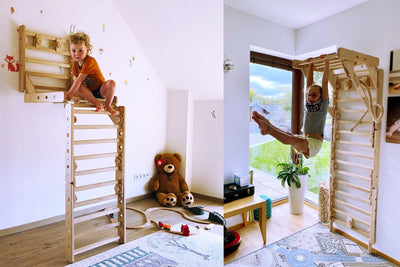
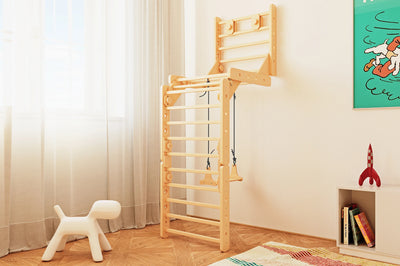
- Wall-mounted (with the W1 wall bracket, included in the set): Wall Swing (H 200 cm × W 60 cm × D 70 cm), Two-panel Wall Bar (H 200 cm × W 60 cm × D 70 cm) and Overhang (H 190 cm × W 60 cm × D 80 cm)
Recommended age according to the product page: 2–10 years; the wall setups Overhang, Wall Swing and Two-panel Wall Bar from 3 years according to the manual. Because of the leverage effect, Wall Swing and Two-panel Wall Bar carry only 15 kg without the H1 bar supports, and up to 100 kg with H1 — the H1 supports are not included in the Cliff set. According to the product page, plan at least 1 metre of clear space around the climbing frame.
Loopo Combo 9-in-1 — 551 € Pikler triangle + wall bars + overhang in one system. The Combo brings together the Mini Gym and Cliff playsets — nine setups, including:
- Small Pikler Triangle T2 (H 46 cm × W 97 cm × D 60 cm)
- Small Bridge and Medium Bridge (H 70 cm × W 80 or 140 cm)
- Wall Bars: H 190 cm
- Overhang and Rib Tables with Pull-up Bar (wall bars with a pull-up bar, H 200 cm)
Recommended age according to the product page: from 3 years. The tall setups are fixed to the wall with the W1 wall bracket; the H1 bar supports, which raise the pull-up bar's load capacity from 15 kg to 100 kg, are included in the Combo. As with the Cliff, you need room for the setup, a crash mat and clear space around it.
Our recommendation:
For a child from 10 months to about 18 months and a standard children's room → Loopo Froggie (from 10 months).
For a child between 1 and 4 years with a bit more space → Loopo Panther (product page: 1–4 years).
For children from about 3 years or families with several children, if wall mounting is possible → Loopo Cliff (wall setups from 3 years) or Combo (from 3 years).
→ See the full Loopo collection
Frequently Asked Questions (FAQ)
Which Pikler size for a 1-year-old child? Small to medium (about 60–80 cm height), from the manufacturer's stated age. At one year, the child usually climbs only short distances and doesn't need much height. But if the triangle is meant to stay for several years, medium is often the better investment.
Which height for 3–6 years? Medium to large (about 80–100 cm or more). In this phase, many children look for more height and challenge. A 60 cm triangle is usually too low for a 4-year-old. With more height, also think about a suitable crash mat.
What's the right rung spacing? There is no single standard value. What matters is that your child can move hands and feet securely from rung to rung, that the manufacturer states the spacing, and that the triangle is tested to EN 71.
Can a Pikler triangle be too small? Yes. If your child climbs up and down the whole triangle effortlessly, without pausing, and shows little interest any more, it has been outgrown. Then either go for a larger triangle or extend it with a slide, arch or bridge.
Is a foldable Pikler triangle worth it? If space is tight: yes. Otherwise not necessarily — with foldable models, pay particular attention to a stable stance and a secure locking mechanism. Modular systems are often the more flexible choice.
Pikler triangle for twins — which size? What matters is the age and climbing ability of both children, not the fact that they are twins. Choose the size according to the manufacturer's recommendations and plan for enough space. If both children are to climb at the same time, two suitable triangles with enough distance between them are one option. Follow the manufacturer's instructions for use and supervise both children.
How much space in the children's room do I actually need? The footprint stated by the manufacturer plus clear space around it for a crash mat and for climbing down, with no furniture or edges within reach. With a slide, add its length plus run-out space. More clear floor area is always an advantage for safe play.
When is a modular system better than a simple Pikler triangle? When the triangle is meant to stay interesting for several years and you don't want to buy a slide, arch or bridge later as separate stand-alone items. With a modular system you buy only the parts you need — though as the maker of such a system, we're not neutral here.
Sources
- Loopo online manual — measurements, age recommendations and load capacity of each setup, W1 wall bracket, H1 bar supports, safety instructions
- Product pages Loopo Froggie 2-in-1, Loopo Panther 3-in-1, Loopo Cliff 7-in-1 and Loopo Combo 9-in-1 — prices, contents, age recommendations (as of November 2026)
- EN 71-1 and EN 71-8 — European toy safety standards (the basis on which the Loopo playsets are tested)