
Wooden Climbing Holds for Kids — Material, Sizes and Proper Installation

If you're planning a climbing wall for the kids' room, you'll sooner or later face the same question: plastic or wood? The range of brightly coloured plastic holds is huge and often cheaper — yet in a child's room there's a lot to be said for wooden climbing holds. They sit more quietly in a room, feel different in a small hand, and they're robust.
For children, a climbing wall is often more than a wall: it's a small courage test in their own room. That's why it's worth getting the material and mounting right from the start. In this guide we'll show you what really matters with wooden climbing holds: material, hold shapes for different ages, safety standards, how many holds you need and how they're mounted — and what of that applies to our own wooden climbing holds.
At a glance
- Material of our holds: beech plywood, 12 mm thick
- Age: according to the product label, our wooden climbing holds are not suitable for children under 3 (small parts)
- In the set: 4 holds (round, square, rectangular, triangular), 4 screws, 1 Allen key
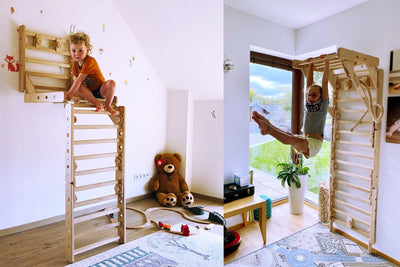
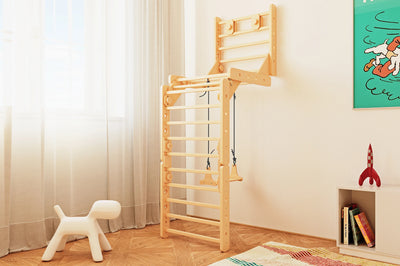
- Mounting: the holds are screwed into the holes of the climbing board; the board hooks onto a Loopo panel or is fixed directly to the wall
- Price: from €21.50 per set (as of November 2026)
- Bonus: the holds can be unscrewed and rearranged as your child grows
Why Wood Instead of Plastic?
Plastic climbing holds are usually cheaper and come in almost every shape and colour — there's nothing wrong with them. For a bouldering wall with frequently changing routes they're a good choice.
For a permanent climbing surface in the kids' room, though, wood has three advantages:
Look in the room. Wood blends into many interior styles — classic, modern or natural. Colourful plastic holds quickly make a room look like a climbing gym; wood is calmer.
Feel. Wood feels different from plastic — warmer, with a fine grain. For children who take in so much through their hands, that's an extra sensory experience.
Robustness and care. A well-made wooden hold is robust. If it gets loose, you tighten the screw. On the natural, unfinished variant, our assembly manual says scratches can be removed by light sanding (grit 180–240) along the wood grain.
Where wood reaches its limits: with sweaty hands and very technical climbing moves, plastic can be grippier. In a kids' room, though, play usually matters more than competitive sport climbing.
Which Sizes for Which Age?
Climbing holds come in many shapes and sizes. As a rough guide:
Under 3 years — check the age label. Many climbing holds contain small parts. According to the product label, our wooden climbing holds and the climbing board are not suitable for children under 3 (small parts, choking hazard). For younger children there are dedicated Loopo setups without climbing holds — our assembly manual recommends the Small Pikler Triangle from 10 months, for example.
3–6 years — large, easy-to-grip shapes. Broad, rounded holds can be wrapped even without much finger strength. A mix of large standing surfaces (for the feet) and medium grasping holds (for the hands) makes a wall interesting. With growing experience, more easy-to-grip shapes can be added. What matters is that your child can wrap their hand securely around each hold.
6+ years — more variety. Older children often look for new challenges. Different hold shapes and more demanding layouts make the wall exciting. The holds should still suit the child's hand size and ability. The Austrian Alpine Club (Österreichischer Alpenverein) explicitly advises against children climbing on holds that are too small, with their fingers crimped, and recommends larger, open holds instead.
A set of four different shapes — round, square, rectangular, triangular — can be a good start. You can expand it later when your child wants something new. You don't have to buy everything at once.
What to Look For

Climbing holds look simple — but a few things are worth checking, with us as with any other maker:
Material. Beech and beech plywood are common materials for wooden holds. Plywood is made of cross-glued veneer layers, which makes it more dimensionally stable than a single piece of solid wood. Pine and spruce are softer than beech and wear faster. Our holds are made of 12 mm beech plywood.
Clean finish. Every hold should have rounded edges and be sanded smoothly enough that no splinters stick out. Simply check this by hand when you unpack them.
Safety standards. Which standard applies depends on what a product is meant for:
- EN 71-8 — safety of toys: activity toys for domestic use for children under 14, including separately sold accessories. For our wooden climbing holds, the product page lists the Toy Safety Directive 2009/48/EC as well as EN 71-8:2018 and EN 71-1 (mechanical and physical properties).
- EN 12572-3 — safety requirements and test methods for climbing holds on artificial climbing structures and bouldering walls, i.e. mainly climbing gyms. It explicitly does not apply to playground equipment.
- EN 1176-1 — general safety requirements for permanently installed public playground equipment. It isn't meant for play equipment in a child's room.
When in doubt, ask the maker which standard a product has been tested to. Reputable suppliers will say openly.
Mounting. Make sure every hold is screwed in, the way the maker intends. Stick-on climbing holds exist, but we wouldn't use them for actively climbing children. Our wooden climbing holds consist of three parts — top piece, base piece and screw — and are screwed into the holes of the climbing board.
How Many Climbing Holds for Your Wall?
There's no universal number — it depends on the area, the child's age and the system. In our system, the climbing board sets the frame:
- Climbing board: 600 × 590 mm, 9 holes for wooden holds or climbing stones
- One set of wooden climbing holds: 4 holds
- Unused holes: are closed with blanking screws for safety. If you order the board together with holds, 5 blanking screws are included; without holds, 9.
One set is a good start: you see how your child responds and add more later. Because the holds are screwed in, you can change the layout as your child grows or invents a new favourite route.
What's easy to underestimate: children rarely climb the whole wall at once. They often climb the same section over and over and invent small variations. A smaller surface with well-placed holds can therefore be more exciting than a big one with too many.
Mounting Step by Step
A typical worry with climbing holds is drilling. In our system, it depends on how you fix the climbing board — the holds themselves are not screwed directly into the wall.
Which Wall Works?
The assembly manual describes two ways to mount the climbing board:
- Hook it onto a Loopo panel: the board must rest on all four hooks, and each hook must sit fully on a rung. Whether the Loopo setup itself has to be anchored to the wall depends on the setup: some stand freely in the room, others are fixed to the wall with the Wall Connector W1. The manual states this for every setup.
- Directly on the wall: the board can also be mounted on a wall without a Loopo panel — with screws suitable for your wall material. The wall must be load-bearing. With drywall, insulated walls or if you're not sure what your wall is made of, get advice from a specialist retailer or a professional first.
Which Screws and Dowels?
- Holds on the board: every set of wooden climbing holds includes 4 screws and an Allen key. Screw the holds into the matching holes on the board and tighten firmly.
- Unused holes: always close them with blanking screws — they come with the climbing board.
- Board directly on the wall: which screws and dowels fit depends on the wall material. Follow the dowel manufacturer's instructions, and if in doubt, ask us or a specialist retailer.
Spacing Between Holds
On the climbing board, the holes define the possible positions. If you build a larger climbing surface with holds from other makers, there's no rigid rule. A few principles still help:
- Match your child's size: your child should reach the next hold without overstretching.
- Mix hand and foot holds: larger surfaces for the feet, easy-to-grip shapes for the hands.
- Not too regular: a slightly staggered pattern keeps the wall more interesting.
Safety at the Climbing Surface
- Soft landing: put a mat or other soft fall protection under the climbing surface.
- Supervision: according to our assembly manual, children under 6 should only use our products under adult supervision.
- Check: an adult checks the setup after assembly. All connecting parts must be fully screwed in and tightened; don't keep using damaged parts.
Wooden Climbing Holds vs Climbing Stones — When What?
Besides the wooden holds, we also offer climbing stones in sizes S and M. Quick breakdown:
| Aspect | Wooden Climbing Holds | Climbing Stones |
|---|---|---|
| Shape | Geometric — round, square, rectangular, triangular | Edgy-organic, stone-like |
| Look | Natural, grey or black; restrained | Colourful or black-grey-white |
| Ideal for | A calm, homely wall | Imaginative climbing, role play |
| Difficulty control | Via shape and position | Via size (S or M) and position |
| Combinable | Yes, with climbing stones | Yes, with wooden climbing holds |
You can mix both on the same board — wooden holds as a calm base pattern, climbing stones as splashes of colour. According to the assembly manual, both are mounted the same way: screwed into the matching holes on the climbing board and tightened firmly.
Wooden Climbing Holds from Antonie Emma

Our wooden climbing holds are made from beech plywood (12 mm). Each set contains four different shapes — round, square, rectangular and triangular — so you start with a small variety of grip options.
You can choose from three variants (prices as of November 2026):
- Without surface finish (natural) — €21.50 per set
- Grey — €23.00 per set
- Black — €23.00 per set
Every set comes with 4 screws and an Allen key. Each hold is made of three parts — top piece, base piece and screw — and is screwed into a hole on the climbing board. The board isn't included in the set and is ordered separately. The warranty is 2 years, or 5 years for registered customers.
Via the climbing board, the holds connect with our Loopo System: the board hooks onto a Loopo panel. If you're not sure whether your setup is suitable, our customer service will help.
Frequently Asked Questions (FAQ)
Which screws do I need for wooden climbing holds? Our wooden climbing holds come with 4 screws and an Allen key; they're used to screw the holds into the holes of the climbing board. For holds from other makers, follow their mounting instructions. To fix the board directly to a wall, choose screws and dowels that suit your wall material.
Which walls can I mount climbing holds on? Our wooden holds don't go directly into the wall but onto the climbing board. You either hook the board onto a Loopo panel or fix it to a load-bearing wall. With drywall, insulated walls or an unclear wall build-up, get advice from a specialist retailer first.
How high should the climbing wall be? There's no fixed height — higher mainly means a longer fall. What matters more is a soft surface underneath, a hold layout that suits your child's size, and supervision: children under 6 should only climb under adult supervision.
From what age are wooden climbing holds suitable? That depends on the product — check the maker's age label. According to the product label, our wooden climbing holds and the climbing board are not suitable for children under 3 because they contain small parts. For younger children there are Loopo setups without climbing holds, such as the Small Pikler Triangle, which our assembly manual recommends from 10 months.
Climbing holds for a rented flat — are there solutions? Yes. First, you can hook the climbing board onto a Loopo panel. Whether that needs drilling depends on the setup: freestanding Loopo setups need no wall fixing, wall-mounted ones are anchored with the Wall Connector W1 — the manual states this for every setup. Second, you can agree on drilling with your landlord beforehand, ideally in writing, and close the holes as agreed when you move out.
How many climbing holds fit on a climbing board? The board has 9 holes. How many of them you fill with wooden holds or climbing stones is up to you — one set of wooden climbing holds contains 4 holds. Close all unused holes with blanking screws.
Do climbing holds loosen over time? Screw connections can loosen with use. So check the holds regularly and retighten loose screws with the Allen key. If a part is damaged, stop using it.
Can I reuse climbing holds somewhere else later? Yes. The holds can be unscrewed and mounted again in a different position or on another climbing board. To keep the wood in good shape, our manual advises protecting it from excessive moisture and from temperatures below 10 °C or above 50 °C.
Sources
- Loopo assembly manual — sections "Climbing Board and climbing holds", safety rules, warnings, care and maintenance; Small Pikler Triangle setup (recommended from 10 months). Accessed 4 Nov 2026.
- Product page: Wooden Climbing Holds — material, package contents, prices, warranty, safety standards and warning. Accessed 4 Nov 2026.
- Product page: Climbing Wall Panel — dimensions, blanking screws, mounting on a panel or on the wall. Accessed 4 Nov 2026.
- EN 71-8:2018 — scope (Genorma)
- EN 12572-3:2017 — scope (Genorma)
- EN 1176-1:2017 — scope (Genorma)
- Austrian Alpine Club youth (Alpenvereinsjugend): 3D Special "Sportklettern mit Kindern und Jugendlichen", December 2018, p. 8 (holds for children; in German)