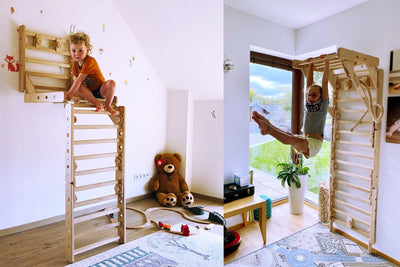

Why Children Love to Swing — What Swinging Does for Balance, Focus and Calm

Why do children love to swing so much — and what does swinging actually do? Swinging engages the sense of balance and is one of the simplest opportunities for young children to practise balance, body awareness and self-regulation through play. Occupational therapists call this "vestibular input" — movement signals for the organ that senses balance, head position and motion. How to mount an indoor swing safely on the ceiling or wall is covered in our guide How to mount an indoor swing for kids.
In this guide, you'll find out what happens in the body when a child swings, what an indoor swing for children can offer in everyday life (and what it can't), how much space it needs, and how to choose the right setup for your child's age and room.
At a glance
- Swinging engages the sense of balance and creates opportunities to practise balance, posture and body awareness — and, for some children, a calm moment in the day
- The vestibular system in the inner ear tells the brain about head movement and head position relative to gravity
- From what age: there's no fixed age; a swing seat is meant for children who can already sit upright securely, and younger children only with you right beside them. Our assembly manual recommends the Loopo Wall Swing from 3 years
- Footprint (Loopo Swing): the wall swing is around 200 × 60 × 70 cm, plus at least 1 metre of clear space in front of and behind the swing
- Tip: modular setups that combine swinging with climbing
Why Do Children Love to Swing?
Inside your child's inner ear sits the vestibular system, the organ of balance. Its semicircular canals tell the brain when the head rotates; two further small organs report the head's position relative to gravity and movement forwards, backwards, up or down. Every time your child rocks, swings, spins or hangs upside down, this system gets movement input.
The vestibular system works closely with the eyes and with the sensors in muscles and joints. According to the US National Institute on Deafness and Other Communication Disorders (NIDCD), it helps the body:
- keep a stable posture — at rest and in motion, when sitting, standing, walking and running
- keep a stable visual focus — even while the body changes position
- keep its balance — together with vision and the sense of the body's own position
Many parents also know this from the baby years: slow, steady rocking is something many children find pleasant. How strongly a child responds to it varies from child to child.
In occupational therapy, swings are among the equipment used to provide vestibular input in sensory-based therapies. The American Academy of Pediatrics points out, however, that research on the effectiveness of these therapies is limited and inconclusive. For a typically developing child, swinging at home is therefore above all one thing: a playful form of everyday movement — not therapy.
Note: This is general information; the sources are listed at the end of the article. If you have a specific concern about your child's development, your paediatrician and, where appropriate, an occupational therapist are the right next step. Nothing in this article is meant as clinical advice.
What an Indoor Swing Can Offer Day to Day
Opportunities rather than promises — that's the most honest way to describe what an indoor swing can do at home:
1. A chance to feel their own body. Swinging brings momentum, acceleration and changes of direction. Your child practises holding on, sitting upright and handling changing forces.
2. A reset for busy days. Rhythmic, predictable swinging can be one way for some children to shift into a calmer rhythm after a hectic day.
3. A movement break before quiet play. Some children find it easier to settle into quiet play after a few minutes of movement. Whether that's true for your child is something you'll notice best yourself.
4. A calm moment in the evening. Slow swinging can be one part of an evening routine — calmer than running around, but still moving the body.
5. A practical answer to "I can't sit still". Some children simply have a lot more urge to move. An indoor swing is one way to give that urge room at home, on days when the playground isn't an option.
Can You Fit an Indoor Swing in a Small Room?
Many families assume an indoor swing means a big, dedicated playroom. It doesn't have to — but it does need some space.
For the wall swing from the Loopo Swing set, you need:
- A free stretch of wall for a construction around 200 cm high, 60 cm wide and 70 cm deep
- At least 1 metre of clear space in front of and behind the swing, so your child doesn't swing into furniture or a wall; a room at least 3 metres deep works well
- A wall where the wall connectors can be anchored securely — the swing doesn't hang from the ceiling but from a wall-mounted construction
In many flats and city homes, this is achievable. The key is choosing a swing on a stable frame rather than hanging it from a hook in a plasterboard ceiling.
Where it gets difficult: rooms where you can't keep a metre clear in front of and behind the swing, heavily furnished rooms with no clear floor space, and walls where secure wall mounting isn't possible. For insulated external walls, mineral-wool walls or unusual wall constructions, our assembly manual recommends asking for advice at a DIY store or specialist retailer first.
What Age Can Children Start Using an Indoor Swing?
| Age | What's developmentally happening (roughly — every child has their own pace) | What swinging can look like |
|---|---|---|
| 0–12 months | The sense of balance is active; many babies find rocking pleasant | Gentle rocking in your arms or on your lap — not a swing yet |
| 12–18 months | Many children stand, take first steps and build balance | Short swinging only once your child sits upright securely — with you right beside them, within arm's reach |
| 18 months – 3 years | More confident walking and first climbing | Slow swinging on a low seat, with you within arm's reach |
| 3–5 years | Coordinated movement, social play | From here our assembly manual recommends the Loopo Wall Swing (from 3 years); swinging combined with other movement |
| 5+ years | Refining motor skills, more risk-taking | More momentum and their own ideas — keep to the load capacity of the specific build |
Before the age of 3, only use swings that are suitable for your child's age. The Loopo Wall Swing is recommended from 3 years.
When a child can swing without you right beside them can't be pinned to an age. It depends on how securely they sit, hold on and get on and off by themselves. Stay nearby for the first few weeks. Worth knowing for families with younger children: the Loopo Swing set also builds a freestanding Pikler triangle (Small Pikler Triangle T2) — from 10 months according to the assembly manual. So your child can climb first and swing later.
Safety — A Sensible Setup, Not a Stressful One
A well-built, correctly mounted indoor swing can become a lasting part of a child's room. The biggest risks usually aren't in swinging itself, but in the mounting, the load and what's within the swinging arc.
Sensible defaults:
- Impact protection: a suitable, non-slip, adequately shock-absorbing safety mat under and around the swing — ordinary rugs and sheepskins are no substitute for proper impact protection
- At least 1 metre of clear space in front of and behind the swing, and enough room at the sides that ropes and seat don't hit anything
- No furniture corners within the swinging arc
- Seat height: for the Loopo swing, the assembly manual puts the seat plate at least 35 cm above the floor
- Respect the load capacity: because of the lever effect, the Loopo Wall Swing takes 15 kg; with the Support Brace H1 (not included in the Swing set) 100 kg. The Swing Classic seat is rated for 80 kg — the lower figure always applies
- Supervision in the first weeks while your child learns the rhythm
- Check regularly — screws and wall connectors tight; the assembly manual says to check the rope at least every 3 months at the friction points (knots, contact with the wood)

Loopo Swing — A Compact Indoor Swing Setup
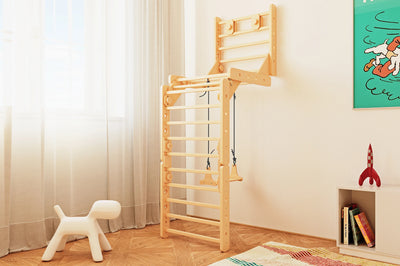
The Loopo Swing 3in1 is a Loopo Playset designed for smaller rooms. It's made of untreated solid beech, and the same parts build three setups:
- As a Pikler triangle (Small Pikler Triangle T2) — freestanding on the floor, for climbing
- As a wall swing (Wall Swing) — mounted on the wall, with the Swing Classic seat hung from a panel rung
- As two-panel wall bars (Two-panel Wall Bar) — also mounted on the wall
The advantage of a swing on a wall-mounted construction (rather than a hook in the ceiling) is straightforward: you drill into the wall, not the ceiling, and there's no need to search for a hidden ceiling joist. It isn't drill-free, though: the wall swing is anchored with two Wall Connectors W1. The screw kit for brick walls (variant A) is included; there are separate anchor kits for plasterboard and timber walls. As a Pikler triangle, on the other hand, the set stands freely and can be moved around the room.
For families who want more variety of movement as the child grows: the Loopo Combo 9in1 also includes the Swing Classic seat and builds, among others, a wall swing, wall bars and an overhang — ideal once your child wants to combine swinging with climbing. The Loopo Mini Gym 5in1, by contrast, focuses on climbing: wall bars, a Pikler triangle and a pull-up bar (Support Brace H1 included) — it doesn't include a swing.
Want a longer view on movement at home? Read our guide on why a climbing frame and wall bars belong in a children's room.
Two Common Worries — Honestly Answered
"My child gets dizzy easily — should we still swing?" Start with short, slow sessions, let your child stop whenever they want, and don't force spinning. Your child sets the pace. If your child repeatedly reacts strongly to even small amounts of motion (nausea, fear, dizziness), talk to your paediatrician.
"Won't they get over-stimulated and become wild?" Some children do get more energetic while swinging — that's normal. It often helps to take the pace down: slow, steady swinging rather than wild momentum or spinning. Watch what works for your child; it usually becomes clear after a few goes.
Building a Loopo Swing Setup — A Quick Walk-Through
If you decide to add a swing to your child's room, setting up the wall swing roughly looks like this:
- Choose the wall — one where you can anchor securely, with at least 1 metre of clear space in front of and behind the future swing
- Install the Wall Connectors W1 following our assembly manual, with the anchor kit that matches your wall (brick, plasterboard or timber); before drilling, use a detector to check where electrical cables and water pipes run
- Hang the swing — tie the rope to a panel rung with a clove hitch, pull the knot fully tight and finish with a safety knot; the seat plate at least 35 cm above the floor
- Lay a safety mat — suitable, non-slip and adequately shock-absorbing, under the full arc; an ordinary rug or sheepskin isn't enough
- Check everything before your child swings — are the Wall Connectors W1 and all other connectors tight, is the knot secure? Don't sit on the wall swing yourself: without the Support Brace H1 it is rated for only 15 kg
The individual steps, dimensions and videos are in our online assembly manual. How long the setup takes depends mostly on your wall.
Frequently Asked Questions (FAQ)
From what age can a child use an indoor swing? There's no fixed age. A swing seat is meant for children who can already sit upright securely; with younger children, stay right beside them, within arm's reach. For the Loopo Wall Swing, our assembly manual recommends an age of 3 years and up.
Do I need a high ceiling? Not for the Loopo Swing: it doesn't hang from the ceiling but from a wall-mounted construction around 200 cm high. More important than ceiling height is at least 1 metre of clear space in front of and behind the swing. For swings hung from the ceiling, the height you need depends on the rope length and the manufacturer's instructions.
What if my child is sensory-sensitive? It's very individual: some children love slow swinging, others quickly feel uncomfortable. Start slowly and let your child set the pace. If your child has known sensory differences or a developmental concern, your paediatrician or an occupational therapist can help you find the right amount.
Will the swing damage my walls? For the wall swing, you drill holes for the two Wall Connectors W1 — those holes remain if you take the construction down again. Choose the anchor kit to match your wall: variant A for brick is included, and there are separate kits for plasterboard and timber. For insulated external walls or unusual walls, ask a specialist retailer for advice first.
What should I look for when buying an indoor swing? The load capacity of the specific build (not just a headline maximum), the age recommendation, how it mounts to your wall or ceiling, and the space it needs including the swinging arc. Loopo playsets meet the toy safety standards EN 71-8:2018 (activity toys such as swings and slides) and EN 71-1:2014+A1:2018; you'll find the current price on each product page.
Can I move the swing between rooms? The wall swing stays where it's anchored; for another room you'd drill again. As a freestanding Pikler triangle, though, the Loopo Swing set can be moved at any time.
Should we use the swing every day? There's no fixed dose for swinging. The WHO recommends that children aged 1 to 4 spend at least 180 minutes a day in a variety of physical activities, spread throughout the day. Swinging can be one part of that — alongside running, climbing and playing outdoors. A few minutes at calm moments, such as before play or in the evening, fit well into many days.
Sources
- National Institute on Deafness and Other Communication Disorders (NIDCD, NIH): Balance Disorders — structure and function of the vestibular system (semicircular canals, otolithic organs), working with the eyes and muscles for stable posture, balance and stable visual focus — nidcd.nih.gov
- American Academy of Pediatrics: Sensory Integration Therapies for Children With Developmental and Behavioral Disorders. Pediatrics 2012;129(6):1186–1189 — swings as equipment in sensory-based therapies; research on effectiveness limited and inconclusive — pubmed.ncbi.nlm.nih.gov
- World Health Organization (WHO): Guidelines on physical activity, sedentary behaviour and sleep for children under 5 years of age (2019) — at least 180 minutes of physical activity a day for 1- to 4-year-olds — who.int
- Loopo online assembly manual (Antonie Emma): builds of the Swing set, Wall Swing from 3 years, 15 kg or 100 kg with Support Brace H1, Swing Classic seat 80 kg, seat plate at least 35 cm, rope check every 3 months, anchor kits by wall material; Small Pikler Triangle T2 from 10 months — antonieemma.com/pages/loopo-manual
- Loopo Swing 3in1 product page (Antonie Emma): package contents, at least 1 metre of clear space in front of and behind the swing, swing seat for children who can sit upright on their own — antonieemma.com/products/loopo-swing