
Wall Bars with Overhang — What They're Really For and How to Choose

When you're looking for wall bars for the kids' room, you'll soon hit two versions: simple wall bars that sit flat against the wall to save space — and models with an overhang on top that makes the whole thing considerably more versatile. At first glance it looks like a small detail, but the overhang changes what your child can do at the wall: from hanging and swinging to harder climbing moves.
So what exactly is an overhang, what is it good for, and when does the upgrade make sense compared to plain wall bars? In this guide we'll give you an honest take — including notes on room height, space, wall mounting and which Loopo playset fits you.
At a glance
- What the overhang is: a section that angles out into the room from the top of the wall bars — for climbing, hanging and as a mounting point for a swing, rings or a rope ladder
- Dimensions (Loopo Overhang): 190 cm high, 60 cm wide, about 80 cm deep
- Age: wall bars and overhang from 3 years according to the Loopo manual; the playsets also include freestanding setups for younger children (e.g. the small Pikler triangle from 10 months)
- Wall mounting: wall bars and overhang are anchored to the wall with the Wall Connector W1 — so you will need to drill
- Space: at least 1 m of free space all around the setup
- Loopo system pricing (as of November 2026): Mini Gym (wall bars) 481 €, Cliff (overhang) 451 €, Combo (the setups of both playsets) 551 €
- Bonus: the modular system can be expanded later with compatible parts, without replacing what you already have
What Is an Overhang on Wall Bars?
Classic wall bars are essentially a vertical wooden ladder, fixed firmly to the wall. They use almost no floor space and give children options to climb, stand, hang and balance.
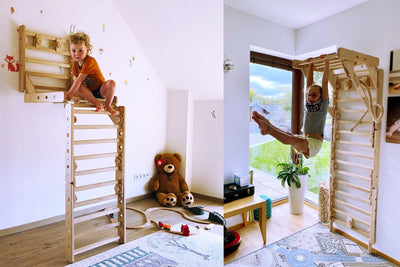
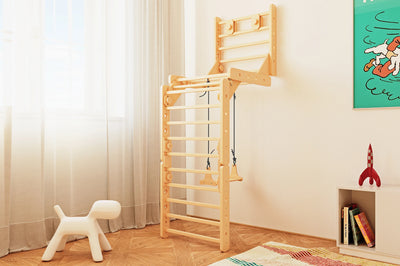
The overhang is an additional element on top — sometimes an angled bar surface, sometimes a horizontal extension, sometimes both combined. It sits a little distance away from the wall, creating a small "space underneath". That's more than just visual: it opens up movement options that plain wall bars don't offer.
At Loopo this setup is called the Overhang. It is part of the Loopo Cliff and Loopo Combo playsets (and of the large Jungle and Universe playsets).
What Is the Overhang Good For? — 4 Main Functions

The overhang is more than an extra — it adds four concrete functions to the wall:
1. Hanging and pull-ups. A setup with a crossbar invites children to hang; hands, arms and shoulders all get involved, and older children try their first pull-ups. Important with Loopo: the load capacity depends on the setup. According to the manual, the Overhang holds 120 kg. In the setups with a pull-up bar (Two-panel Wall Bar, Wall Swing, Rib Tables with Pull-up Bar), a lever effect limits the load on the bar to 15 kg; with the Support Brace H1 it rises to 100 kg. The H1 is included with Mini Gym and Combo, but not with Cliff.
2. Mounting point for swings, rings, rope ladder. Good to know: you don't need a ceiling hook for an indoor swing (which is tricky with drywall ceilings anyway). The swing or gym rings are attached to the setup itself. The setup, however, is anchored to the wall — more on that in the wall-mounting section.
3. Harder climbing. An angled overhang surface challenges children differently from vertical wall bars. They need to use their arms more actively and shift body weight more deliberately. It's not about turning the room into a climbing gym — it's a natural next step once plain wall bars start to feel too easy.
4. More "play modes" — but more space in front of the wall. The overhang adds new setups: Mini Gym offers 5 setups, Combo 9 — including the Overhang, the Wall Swing and two bridges. In return, the Overhang projects about 80 cm into the room (Wall Bars only 10 cm), and you need at least 1 m of free space all around. One day the child swings, the next day they climb the overhang, the day after they just hang from the bar. It's this variety that can keep the wall interesting over years.
How Much Ceiling Height Do You Need?
This is one of the most common questions before buying — and the answer depends on the specific setup, not on a blanket minimum height.
Judging Your Room Height
- Setup height: the Loopo Overhang and Wall Bars are 190 cm high; the Wall Swing, Two-panel Wall Bar and Rib Tables with Pull-up Bar are 200 cm.
- Headroom: subtract the setup height from your room height. What's left is the space above the highest point your child can climb to — make sure they can't bump their head there.
- Swinging: the swing hangs from the setup, not from the ceiling. For swinging itself, what matters is the height of the setup and the free space in front of and behind it.
Measure carefully, especially under sloping ceilings and in low rooms. If no setup with an overhang fits, wall bars without an overhang are the simpler choice.
How Far Does the Overhang Project into the Room?
The Loopo Overhang is about 80 cm deep; the Wall Swing and Two-panel Wall Bar project 70 cm into the room. For comparison: Loopo Wall Bars without an overhang are only 10 cm deep.
Practical tip: before buying, measure not just the room height but also how much floor space you can really leave free. Plan at least 1 m of free space all around the setup so your child doesn't hit furniture when jumping off. If a swing is hung, you need at least 1 m in front of and behind it; a room at least 3 m deep is recommended.
Wall Bars with Overhang vs Without — When Is What Worth It?
| Aspect | Wall bars without overhang | Wall bars with overhang |
|---|---|---|
| Depth into the room (Loopo) | 10 cm (Wall Bars) | about 80 cm (Overhang) |
| Hanging and pull-ups | possible with a pull-up bar (Rib Tables with Pull-up Bar) | yes |
| Swing attachable | only on the setup with a pull-up bar (Rib Tables with Pull-up Bar), with the Support Brace H1 according to the manual | yes — the Swing Classic is part of the Overhang setup |
| Climbing variations | limited | more |
| Wall mounting | yes (W1) | yes (W1) |
| Loopo playset price (as of November 2026) | Mini Gym 481 € | Cliff 451 €, Combo 551 € |
Plain wall bars are enough if:
- the room is too low or too small for a setup with an overhang
- you have just one child who'll soon be out of the active climbing phase anyway
- you need a very space-conscious solution (studio, small flat)
Wall bars with overhang are worth it if:
- you have multiple children or are planning siblings
- you want to integrate a swing into the kids' room
- you want the wall to stay interesting for several years — ideally into primary school
- you want a modular system that adapts to different phases
What Can You Attach to the Overhang? — Swing, Rings, Rope
The Loopo system offers four classic movement elements that you attach to the setup:
Swing. The Swing Classic in beech plywood is included with Cliff and Combo. According to the manual, the ropes are tied to a panel rung with a clove hitch; the video guide on the product page shows how. Important: check the ropes at least every three months for wear at the knots and where they touch the wood.
Gym rings. Swinging and pulling up call for strength and coordination. According to the product description, the rings are not a toy and should only be used under supervision.
Climbing rope. A jute rope (2.1 m long, 25 mm thick) for climbing up. With enough room height, a great bonus.
Rope ladder. Five solid beech rungs on two ropes — a wobbly challenge for arms, legs and balance.
For setups with a pull-up bar: the manual names the Support Brace H1 as necessary for safely hanging swings, gym rings, the rope ladder or the Poma swing. At Loopo these elements can be combined individually — you choose what fits your everyday play.
Wall Mount vs Freestanding

Classic wall bars are screwed firmly to the wall. The same applies to Loopo: whether a setup stands freely or is anchored to the wall depends on the individual setup — that's what the Loopo manual says.
Wall-mounted (with the Wall Connector W1) at Loopo are, among others:
- Overhang
- Wall Bars and Rib Tables with Pull-up Bar
- Wall Swing and Two-panel Wall Bar
Freestanding without wall mounting are, for example:
- the Small Pikler Triangle T2
- Push-Upper
- Small Bridge and Medium Bridge
So at Loopo, wall bars with an overhang are always anchored to the wall. The W1 connectors go at the top and bottom of the setup. Mini Gym, Cliff and Combo come with Wall Mounting Kits A (brick); for plasterboard (kit B) or wood (kit C) there are separate anchor sets. For thermally insulated outer walls, mineral-wool walls or anything unusual, the manual recommends taking the W1 to your local hardware specialist for advice. In a rented flat, it's best to clarify drilling with your landlord beforehand. If drilling isn't possible at all, the freestanding setups from the same playsets remain.
Size Recommendations by Age
- Under 3 years: no wall bars or overhang yet. The same playsets do include freestanding setups for younger children: the small Pikler triangle (from 10 months according to the manual), Push-Upper and Small Bridge (from 14 months).
- From 3 years: Wall Bars, Overhang, Wall Swing, Two-panel Wall Bar and Rib Tables with Pull-up Bar — climbing the wall bars and onto the overhang, swinging, hanging.
- Older children: pull-ups, rings, more demanding climbing variations. For the pull-up bar: a maximum of 15 kg without the Support Brace H1, up to 100 kg with H1.
Wall bars can be used differently across several stages of development — not because they physically grow, but because the play and movement possibilities change with age. The same wall is used at 3 for first climbs and a few years later for pull-ups. And whatever the age, the product page says: use Loopo playsets only under the direct supervision of an adult.
Loopo Mini Gym + Cliff + Combo — Modular System with Overhang
If you want to actually build a "wall bars with overhang" setup, the Loopo system gives you three options:
Loopo Mini Gym 5-in-1 — 481 € The wall bars as a modular playset. From the parts you build 5 setups: Small Pikler Triangle T2, Push-Upper, Two-panel Wall Bar, Wall Bars and Rib Tables with Pull-up Bar. The Support Brace H1 is included. Ideal as the entry point into the system.
Loopo Cliff 7-in-1 — 451 € The overhang as a standalone playset. 7 setups — from the small Pikler triangle and two bridges to the Overhang and the Wall Swing; the Swing Classic is included, the Support Brace H1 is not. If you already have a Loopo Mini Gym and want to add the overhang, this is the one.
Loopo Combo 9-in-1 — 551 € (recommendation) Wall bars with overhang in one playset. Combo brings together the setups of Mini Gym and Cliff: 9 setups, including Wall Bars, Overhang, Rib Tables with Pull-up Bar and Wall Swing. The Support Brace H1 and the Swing Classic are included. If you're looking for exactly this combination, Combo is the obvious choice.
Loopo Universe 40-in-1 — 1303 € The largest playset, for families with more space, multiple children or the wish for maximum flexibility. Up to 40 setups — from wall bars to overhang, slide and bridge, all the way to play courses.
All four playsets are made of solid beech and beech plywood, untreated (sanded only), meet EN 71-1 and EN 71-8 and are compatible within the modular system. The setups with wall bars and overhang are mounted on the wall. You can start small and expand later — adding Cliff to Mini Gym is just as feasible as going straight to Combo.
→ See the full Loopo collection
Frequently Asked Questions (FAQ)
How high does the ceiling need to be for wall bars with overhang? There is no blanket minimum — it depends on the setup. The Loopo Overhang is 190 cm high, the Wall Swing and Two-panel Wall Bar 200 cm. Subtract that height from your room height: what's left is the headroom above the highest point your child can climb to.
Can I add an overhang to my existing wall bars later? With classic wall bars, usually difficult — they're not designed for later expansion. In the Loopo system the parts are compatible: add a Cliff to a Mini Gym and you can build the Overhang too.
Which swing fits onto the overhang? The Loopo system offers the Swing Classic, the Poma swing (from 3 years), gym rings and a rope ladder. The ropes are tied to a panel rung with a clove hitch. Check the load capacity of the specific setup in the manual: on the pull-up bar it is only 15 kg without the Support Brace H1, 100 kg with H1. Check the ropes at least every three months.
How do I fix wall bars firmly to the wall? With Loopo, using the Wall Connector W1, mounted at the top and bottom of the setup. The playsets with W1 include Wall Mounting Kits A (brick); for plasterboard (B) and wood (C) there are separate anchor sets. The online manual shows the mounting step by step, with a video. For wall bars from other manufacturers, follow their mounting instructions.
Do I need fall protection mats under the overhang? Recommended, especially when there's active climbing or swinging underneath. Choose a gym or sports mat that covers the area under and in front of the setup. We don't sell mats ourselves.
From what age does an overhang make sense? From 3 years according to the Loopo manual — the same applies to the wall bars, the Wall Swing and the setups with a pull-up bar. For younger children, the same playsets include freestanding setups such as the small Pikler triangle.
What if my children are different ages? Wall bars with overhang offer siblings a wide range of options — climbing, hanging, swinging. The condition is the setup's minimum age: wall bars and Overhang from 3 years according to the manual. Let the children take turns so that only one child at a time is in the movement area of the swing and the climbing surface, and stay with them — Loopo playsets are to be used only under the direct supervision of an adult. For a sibling under 3, freestanding Loopo setups suited to their age work instead, e.g. the small Pikler triangle (Small Pikler Triangle T2, from 10 months). Keep the setup's load capacity from the manual in mind.
How much space do I really need? The Loopo Overhang is 60 cm wide and about 80 cm deep. Plan at least 1 m of free space all around. If a swing is hung, you need at least 1 m in front of and behind it; a room at least 3 m deep is recommended.
Sources
- Loopo online assembly manual — setups (freestanding / wall-mounted), recommended age, load capacity and dimensions per setup, Support Brace H1, wall mounting with W1, rope care (accessed 4 November 2026)
- Loopo Cliff 7-in-1 product page — dimensions and free space around the setup
- Loopo Swing 3-in-1 product page — free space for swinging
- Loopo Combo 9-in-1 product page — contents, material, standards, supervision note